
Why We Reach for the Wrong Things (And Why It's Not Your Fault)
What neuroscience, motherhood, and a glass of wine taught me about self-sabotage

Yesterday I shared a post over on my Instagram about things I‘m not doing as a yoga teacher and a wellness advocate. We all know the shiny Instagram posts by health experts that tell us to never drink coffee on an empty stomach, especially as women (total hormone interrupter). Or to turn off screens at least 2 hours before bed. The list is long and I know that they are all right and well meant. And still, I don‘t do them. Not because I don‘t want to but because I can‘t get myself to do it.
Turning screens off two hours before bed? Sheer impossible. I‘m a Mom of 2 young children and the evening is most of the time the only undisturbed window where I can finish work, research something or just consume a cozy Vlog on YouTube. I know, I know. But it‘s just what I like doing. I have to be honest though, my sleep quality is not affected by it or has ever been. I may feel it later in life but now - when my kids let me - I sleep like a baby. Talking about sleep and having two young children under the age of 5, I can be very tired in the morning. Especially, when my two year olds decides to wake up frequently to cuddle or be soothed back to sleep (which I‘m happy to do). But then he also likes to wake up at 5.30 AM and now that I‘m not breastfeeding anymore I‘m just exhausted. So I need my cup of coffee first thing in the morning and yes, I‘m drinking it on an empty stomach. I know it is not the best for us women hormone wise but honestly I can‘t function without. Motherhood is a special season and I guess special seasons need special practices. So here we are!
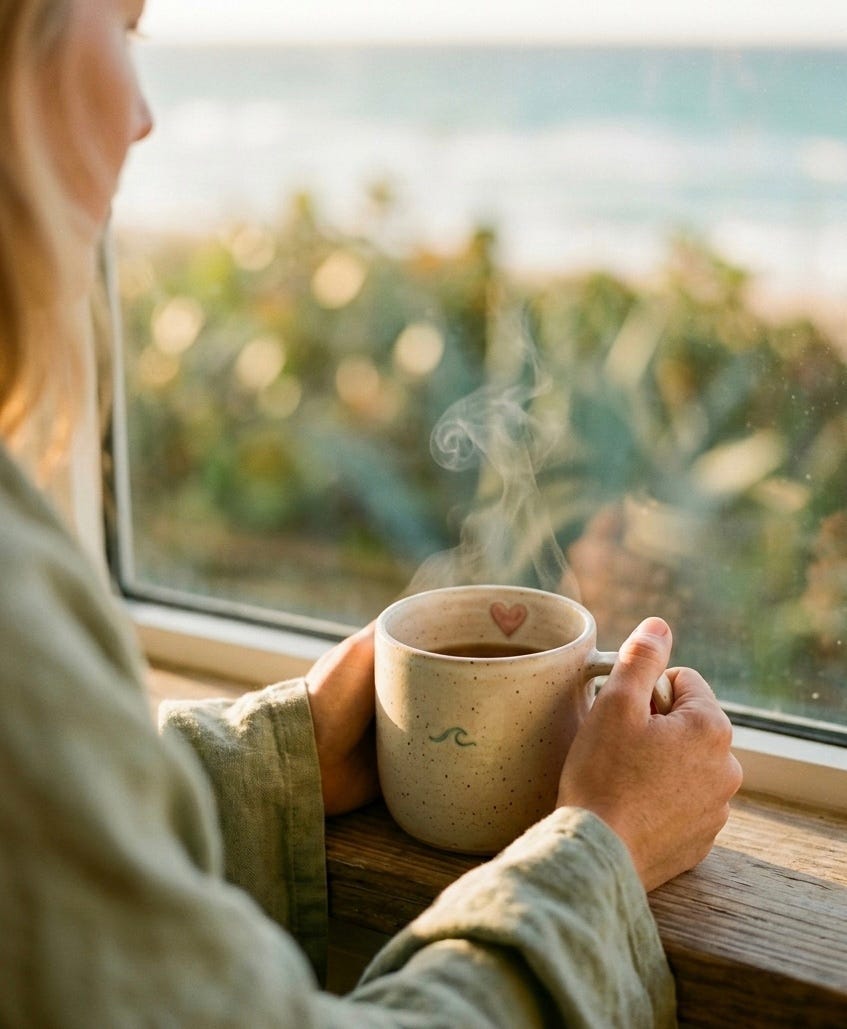
Next on my list of health no go‘s? Drinking alcohol! I just love a glass of champagne or wine, especially after a long day to unwind. I also like the test. But..spoiler alert! I have cut out alcohol for Lent this year and I‘m surprised how easily and better I can unwind with a soothing cup of tea. I will do a whole Substack post about my Lent experience after Easter so stay tuned for that and make sure to subscribe.
I could continue on and on and if you want to know what else I‘m not doing that I should no better of, then head over to my Instagram post. But this is not the topic for this post. The topic I would actually like to talk about today is ‚Why we don‘t do the things that are actually good for us?‘. Why do we reach for the glass of wine when we know it does disturb our sleep, fire our sugar cravings, and makes us a little dizzy? Why can‘t we just grab the cup of tea instead? And I‘m not talking about minor things like having a glass of wine every once in a while or watching Netflix until the wee hours. I‘m talking about unhealthy choices that will eventually wreck havoc on our health.
I know of people that already experienced a near stroke because of their high visceral fat but they are still eating bread, cheese, and cream rich dishes all day long. I know of people whose weight reached a point where their health is negatively affected and they still reach for the bag of gummy bears every day. So I wonder, is it a matter of missing discipline or is it something far deeper. Something inside of our subconscious that prevents us from making the right choices and hanging into our loop instead?
Since I‘m no expert in this field and it would probably take me days and hours to research to then find some vague answers, I asked Claude. I recently switched over from ChatGPT as their guidelines are aimed more towards humanity (it can be a PR gig or something genuine, I‘m just believing the latter one for now). And here it was it said:
The Brain is Wired for Efficiency, Not Optimization
The human brain evolved over hundreds of thousands of years in an environment of scarcity. Conserving energy, seeking immediate rewards, and avoiding effort weren’t character flaws — they were survival strategies. That wiring hasn’t changed, but our environment has changed dramatically. We now live in a world engineered to exploit those ancient instincts at every turn.
The Core Mechanisms at Play
1. The Dopamine Trap
Ultra-processed foods, social media, and other “easy” pleasures are specifically designed to trigger dopamine hits — the brain’s reward chemical. These artificial dopamine spikes are far more intense than what you’d get from an apple or a walk. Over time, your brain recalibrates its baseline, making natural rewards feel dull and effortful choices feel even harder. This is neurological, not moral.
2. Present Bias
The brain dramatically discounts future rewards compared to immediate ones. The pleasure of chips right now feels more real than the energy and health you’d feel in three months from eating well. This is called hyperbolic discounting — and it’s baked into how our prefrontal cortex weighs decisions, especially when we’re tired or stressed.
3. Ego Depletion & Decision Fatigue
Willpower is a finite resource that depletes throughout the day. Every decision — big or small — draws from the same cognitive reservoir. By the evening, when most people make food and lifestyle choices, their capacity for effortful decision-making is already spent. This is why “just try harder” advice fundamentally misunderstands the problem.
4. Subconscious Programming (You’re right to flag this)
This is huge. Much of behavior is driven by deeply embedded mental models formed in childhood — around food, comfort, reward, and self-worth. If chips and TV were how your family unwound, that association is neurologically encoded. Comfort eating, for example, is often the nervous system seeking regulation, not the conscious mind making a lazy choice. Trauma, chronic stress, and attachment patterns all live in the body and shape behavior well below the level of conscious choice.
5. The Environment is Rigged
Processed foods are cheap, heavily marketed, and engineered by food scientists to be hyper-palatable. Gyms cost money. Healthy food requires preparation. The “easy” path isn’t a coincidence — it’s a profit model. Framing this as a personal discipline failure ignores the systemic architecture of modern life.
6. Identity and Self-Concept
People don’t just make choices — they act out who they believe they are. If someone’s identity is “I’m not the kind of person who works out,” no amount of willpower will sustain change. Long-term behavioral change almost always requires an identity shift first, not just motivation.
So Is It Discipline?
Discipline plays a role, but it’s downstream of everything above. Relying on willpower alone to override neurological wiring, subconscious programming, and an engineered environment is like swimming upstream every day and blaming yourself for getting tired. The people who seem most “disciplined” have usually just built environments and identities that make the good choice the easy choice — they’ve removed the need for constant willpower.

WOW, how interesting! Isn‘t the human being just an intriguing thing? I can say for myself that winding down in front of the television eating something comforting was definitely a thing in our family. And something I adapted. The same goes for eating. Don‘t feel well? Here you have some chocolate or other comfort food that makes you feel better. Feeling stressed? Have a glass of alcohol. So naturally I tend towards these things when feeling unbalanced.
But I also always been into health and wellness so I started to see things from a different perspective heading into my twenties. And I tried to break the cycle. Some things took me years though until they were finally worked through. Giving up on binge eating chocolate for example. Some naturally disappeared when I became a Mom which I find rather magical. And I really want to write an article about how motherhood really changes you from the inside and out. Until then I can recommend this article beautifully written by my fellow Substacker (is this a thing?!) Alyssa Brieloff.
So how did I work through the things I didn’t want to repeat or lean on anymore when feeling stressed or not myself?
I think it started with compassion. Real, unglamorous compassion — not the candle-lit, journaling kind (though that too, of course). The kind where you catch yourself reaching for the wine or the phone or the biscuit tin and instead of the familiar wave of guilt, you pause and say: oh, there she is. And awareness. I became aware of my patterns and that made it easy for me to catch me in the act and chose a different path.
Because that’s what most of our loops are, at their core. A nervous system doing its best with what it was taught.
The shift doesn’t happen through more discipline. It happens through awareness, slowly and gently, the same way we try to parent our children — with curiosity rather than punishment.
Here is one small thing I’d invite you to try this week:
The next time you reach for something you “shouldn’t” — the glass of wine, the scroll, the late-night snack — don’t stop yourself. Just pause for three breaths first and ask: what am I actually needing right now?
Not to change it. Not to judge it. Just to know.
That tiny gap between impulse and action is where everything begins to shift. Slowly. Gently. On your own timeline.
And if tonight you still choose the wine? Pour it slowly. Taste it. Be present with it. That’s not failure — that’s being human.
I’d love to know — what’s one habit you recognize in yourself? Come find me on Instagram or reply to this email. This is the kind of conversation I live for.
XOXO,
Madeleine